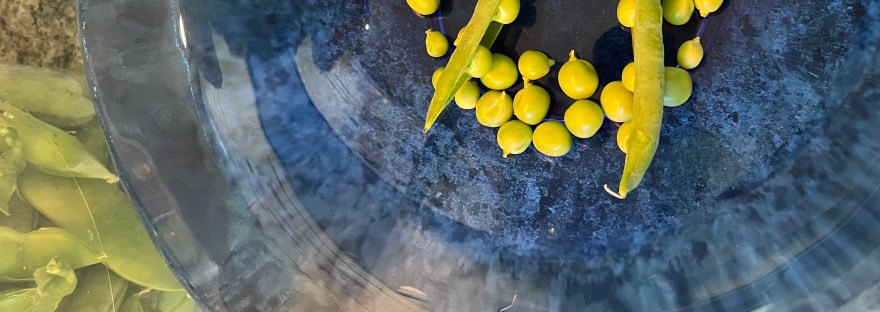
Pop. My thumb and forefinger press open the tip of the pea pod picked just this morning. Down the firm pod’s length my thumb drags the shell apart, crackling, to expose the peas in their matching rows. Now my thumb rolls out the peas to tumble – ping, ping – into a blue glass bowl. The touch and sound, the fresh taste, propel me, unexpectedly, so vividly to my mother’s side that the emotion catches in my throat. She would have loved to know I was picking peas, laughed to remember back to the summers when I ate my childish way through our pea patch.
Our home back in Surrey was a fruitful place in which to grow up. Perhaps, in some ways, it was not as fruitful as the house next door (seven boys!) but to me there was abundance wherever I looked, from spring through to fall. Our block on 140th Street was a line of modest, post-war acreage homes (enormous lawns in front, blocks of west coast forest behind) all facing across the road to the seemingly endless cedar groves of the B.C. Forestry grounds. It was wild and it was cultivated, and both were prolific.
In the early spring, coastal rains made the wild fringes of our forest bud and blossom. While fruit trees in our yard burst into blossom, tall, greening canes flowered pink along the roadside ditches where wild salmon berries would fruit in May and June. I watched eagerly for the ripening, raspberry-like berries, hanging apricot-orange or deep red – not dull like real raspberries, but glowing, bright. I needed some spring in my little legs in order to leap the ditch, landing (most times) on dry ground from which to pick handfuls of mellow, seedy salmon berries.
In June my mother (and me as the only daughter) commenced her summer berrying with a Saturday or two in the “pick-your-own” strawberry fields up the Fraser Valley. Squatting beside the long, low rows, our fingers stained red (my mouth, too), we methodically filled every bucket, pail, and roasting pan which we had packed into the trunk of the blue Ford. We picked for long hours, stopping only to eat our packed lunch, for Mom to drink coffee from one of Dad’s old brown thermoses, or to trudge to an outhouse at the edge of the field. For days afterward, we were surrounded in the kitchen by containers of strawberries, washing, hulling, freezing the good ones, mashing the messy ones for jam, eating our fill.
After strawberry season came the raspberries. Once again, we dressed in our stained berry-picking clothes and drove to the “u-pick” fields. Raspberries were more work, smaller than strawberries and the canes were thorny, but because the fruit was so delicious they were worth the stretching and bending and scratched arms. Back in the kitchen we began the familiar routine of sorting, filling bags to go into the freezer, mixing jam, making a few jars of preserves.
On our own property, the fruit trees began to produce. Dad set up his ladder under the cherry tree, tying glittering strips of tin foil to its branches in an attempt to ward off eager birds. Next to the long gravel driveway stood a prolific blue plum whose fruit dangled in glory along the drive, enticing the mailman to pause in his rounds to pick a handful. I sensed my parents’ pride in the plum’s shimmering abundance from year to year, “loaded!” they would exclaim to one another with bright faces. Blue plums did not appeal to my taste, but a short run from them, under the big maple tree and past the azalea, stood a yellow plum into whose low branches I could easily swing. Propped against a branch, sun warm on my back, the firm golden-green fruit hung within arm’s reach.
Dad greatly appreciated fruit preserves. Most evenings after supper I would be sent to the storage room, where quart jars of colourful fruit stood in gleaming rows, to pick a dessert which would be ladled out into glass bowls and passed around the table. My mother applied herself with all the vigour of her Norwegian heritage to the yearly task of filling those shelves. Besides using our own cherries and plums, Mom watched for when boxes of fresh apricots, pears, and peaches arrived from the Okanagan for purchase; then the canning would truly begin. Out would come the black enamel canner with its wire cage that fit inside to hold the quart jars. Out would come carefully saved jars from the previous year to be washed and sterilized. Out would come new sealing lids and bags of Roger’s sugar for making the syrup.
Apricots were first and easiest to prepare. They needed nothing more than a wash and a quick slice around the suture line so one could remove the brown pit, then slip the two halves into the lines of jars being prepared to go into the canner.
Yellow Bartlett pears took more work. The skin of each needed first to be peeled away before the fruit was sliced open to reveal its seedy centre. Those balded pears bruised easily, so we held each gently cupped inside our palms as we cut away the seeds. We sliced the fruit with precision so that each jar was as full as it could be and we worked quickly so that fruit would not brown from exposure to the air.
Freestone peaches were best for canning, according to Mom, but the fuzzy skin needed to be removed. With the plug firmly in the kitchen drain, we carefully set the ripe peaches onto the sink bottom, then poured scalding hot water over each peach until they sat immersed. After a few minutes we gently lifted them out, one at a time, hoping that the skins would now slip easily off of the fruit. If not, we eased off the skins with our paring knives, delicately slicing away sections of the slippery, hot peaches. The peaches were slipped, glistening gold, into their jars and covered with canning syrup. Mom wiped the rim of each jar with her cloth to remove any bit of skin or peach fuzz that might interfere with proper sealing of those jars when we tightened on the lids. At last, each quart went into the boiling canner before finally being lifted, one by one, out of the water and wiped with the cloth my mother hung over her shoulder. She set them in rows along the back of the counter until they had cooled enough for her to test the seal of each jar. If they’d not sealed properly, they would not keep through the winter.
The sweet, delicate smell of hot, peeled peaches was one of the best smells ever.
During those summer days when I left my mother in the kitchen with the canner boiling or squatting in the garden picking peas and beans, I often made for the woods seeking round red huckleberries. I loved to find a good branch of them (they seemed to grow well on the tops of old stumps), carelessly break it off, and sit at my leisure in the shade of the cedars, stripping the tart, seedy fruit before discarding the naked branch. In contrast, blackberries spilled out from the edges of the woods on over-arching, writhing canes thick as your dad’s thumb and all covered in long, hard thorns. A small child required protection to pick blackberries – a heavy, long-sleeved jacket and jeans for reaching on tiptoe through the brambles, straining to pluck the sweet, sun-warmed giants away up top, just beyond one’s scratched, purpled fingers.
In late July or early August, the old brown thermos was pressed into service once more. Mom drove to our favourite blueberry patch for my favourite berries. That was always a happy day, easily picking from bushes free of prickles and tall enough for us to stand. Together we filled the roasting pans with silver-blue beauties, round and sometimes as big as a quarter. Once washed, we poured them into freezer bags and laid them among the frozen peas, ice cream, and moose meat.
With the arrival of September’s shorter days and soft sunshine, at last Mom would gladly announce that the firm, tart Transparent apples on the tree next to the house were ripe. Dad brought out his ladder once more, picking the apples gently into pails. Side by side in the kitchen, I fumbled to help Mom peel away piles of pale green skins from the apples before slicing them into freezer bags for use in Mom’s delicious pies.
From garden, from orchard, or plucked from the wilds, the bounty and beauty of growing things sustained us. My own small fingers did very little planting, but I learned early an innocent confidence that by autumn the freezer would fill and the storage shelves groan with good things to see, touch and ultimately taste. Out of their hard childhood experiences of the Depression, my parents (especially my mother) gave themselves gladly to cultivating and to receiving fresh produce with gratitude and celebration. As family we took pleasure in and preserved those good things, knowing we would savour them again together around our simple table.
It moves me when I think of myself at seven or eight years old, sitting as I often did in the upper branches of the Big Maple, contentedly surveying the richness, the abundance, and the beauty of that acre that was home. I carry its fruit inside me still, and it nourishes me.

 Darlene Pinter
Beautiful.
What great memories. Auntie Ellen was such a positive influence to so many. We visited your family at that acre and I’m sure we were the recipients of your efforts!
Sandi, how lovely to hear from you. Thank you for sharing your memories of Mom and of our place from so many years ago.
I thought this was your best yet! You have such powerful gifts of distilling memories, of observation and description. I was right there smelling, tasting, feeling – it evoked feelings of nostalgia and joy. And I just liked the little girl you described – your young girl self – so much!
I was moved by your lively gratitude. Thank you , Darlene!
Thank you Catherine. I’m so glad that you connected with this piece.
Loved this story of your fruitful family. There truly is nothing better than BC fruit ! I too remember picking berries in the Annapolis Valley ,NS. Blueberries have also been my favourite berry . Thanks for this delicious story, Darlene❣️